

- Heir vs Beneficiary: Who Has Greater Right to Your Estate?
- What Is an Heir Under California Law?
- What Is a Beneficiary Under California Law?
- Heir vs Beneficiary: Key Differences
- Why Does the Difference Between Heirs and Beneficiaries Matter?
- How Can You Reduce Confusion Between Heirs and Beneficiaries in Estate Planning?
- FAQs About Heirs and Beneficiaries
- Final Takeaway
Updated on February 16, 2026
Heir vs Beneficiary: Who Has Greater Right to Your Estate?
Understanding the difference between an heir and a beneficiary is a key part of estate planning and probate administration. While these terms are often used interchangeably, they have very different legal meanings under California law. Knowing how they differ helps ensure assets are distributed according to legally recognized instruments such as a will, trust, or beneficiary designation, and can reduce the risk of disputes in probate court.
In California, the distinction affects whether property passes through intestate succession under the Probate Code or by designation through a governing instrument. Clarifying this difference early can help avoid unintended outcomes involving inherited real property, financial accounts, or trust assets.
What Is an Heir Under California Law?
An heir is a person who is legally entitled to inherit property when someone dies without a valid will or trust, a situation known as dying intestate. Under California intestate succession laws, heirs are determined by statute rather than by personal choice.
Dying intestate typically requires the estate to pass through probate court, where a judge oversees the administration of probate assets and confirms the legal heirs. This court-supervised process can involve filing petitions, providing notice to interested parties, and following the order of distribution established by the California Probate Code.
For a broader explanation of when court administration is required, see our discussion on probate when is it necessary.
Key Characteristics of an Heir in California
- Heirs inherit under California intestate succession statutes
- They are typically close family members, such as a surviving spouse, children, parents, or siblings
- The order of inheritance is determined by state law, not by a decedent’s personal preferences
- Heirs generally inherit only when no valid estate planning document directs otherwise
For example, if someone dies without a will in California, their estate may pass to a surviving spouse and children according to Probate Code distribution rules, regardless of informal statements or intentions made during their lifetime.
In many cases, understanding whether probate is required depends on the type of property involved and whether the decedent left a valid estate plan.
What Is a Beneficiary Under California Law?
A beneficiary is a person or entity specifically named in a legal instrument—such as a will, trust, life insurance policy, or retirement account—to receive assets upon someone’s death. Unlike heirs, beneficiaries are determined by designation rather than by intestate succession laws.
In California, beneficiary rights arise from the governing instrument that controls the asset. This may include a last will and testament, a revocable living trust, or a beneficiary designation form associated with financial accounts. Many of these transfers are considered non-probate assets, meaning they pass directly to the named beneficiary without court-supervised administration.
For additional context, see our overview of properties not subject to probate.
Key Characteristics of a Beneficiary
- Beneficiaries are chosen by the individual who owns the assets
- They can be any person or organization, including friends, charities, or non-relatives
- Their rights come from written legal documents
- Named beneficiaries often receive assets outside of probate, meaning they get to avoid the time and expense of the court system.
For example, a life insurance policy or retirement account typically pays directly to the named beneficiary, even if the individual would not qualify as an heir under California law.
Understanding whether an asset passes by beneficiary designation or through probate depends on the type of property and the language of the controlling document.
Heir vs Beneficiary: Key Differences
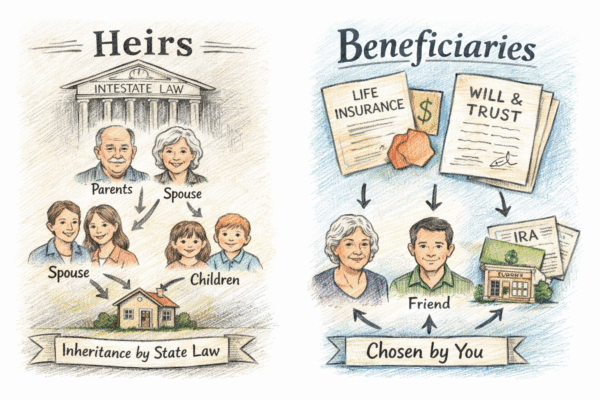
| Heir | Beneficiary |
|---|---|
| Determined by California intestate succession statutes | Named in a will, trust, or beneficiary designation form |
| Inherits when no valid will or trust controls distribution | Receives assets by designation rather than by statute |
| Typically limited to legally recognized family members | May be any person, trust, or legal entity |
| Rights generally arise through probate court administration | Often receives non-probate assets outside court supervision |
The primary distinction is that heirs inherit by operation of law when no controlling estate plan exists, while beneficiaries inherit through deliberate designation in a governing instrument. In California, beneficiary designations for certain financial accounts and insurance policies typically control distribution even if intestate succession rules would otherwise apply.
Understanding this structural difference helps clarify why some assets pass through probate court while others transfer directly to a named recipient.
Additional discussion on whether court involvement is required can be found in is probate required if decedent had a will.
Why Does the Difference Between Heirs and Beneficiaries Matter?
The distinction between heirs and beneficiaries can significantly impact how an estate is distributed under California law. Assets with named beneficiaries—such as life insurance policies, retirement accounts, or transfer-on-death designations—generally pass outside probate and override intestate succession rules, and in many cases even the terms of a will. Without clear and updated beneficiary designations, state law may distribute probate assets in a manner that does not reflect the decedent’s intended plan.
Failing to name beneficiaries or to review estate planning documents after major life events can result in unintended transfers, court-supervised administration, and disputes among surviving family members.
At Schorr Law, real estate disputes frequently arise in situations involving both heirs and named beneficiaries. More often than not, the conflict centers on inherited real property, where multiple beneficiaries receive an interest but cannot agree whether to retain, sell, or partition the asset. Related reading includes sell inherited property, post probate partition, and 5 tips for partitioning real property with family.
In these disputes, clarifying whether a person’s rights arise by statute or by designation often helps define the legal path forward.
How Can You Reduce Confusion Between Heirs and Beneficiaries in Estate Planning?
- Create a valid will or revocable living trust that clearly identifies how probate and non-probate assets should be distributed
- Name and confirm beneficiaries on all financial accounts, retirement plans, and life insurance policies
- Review and update estate planning instruments after major life events such as marriage, divorce, birth of a child, or acquisition of real property
- Work with an experienced estate planning attorney to ensure documents are legally sound
Clear documentation helps prevent unintended application of intestate succession statutes and reduces the likelihood of probate disputes among heirs and designated beneficiaries.
FAQs About Heirs and Beneficiaries
Q1. Can someone be both an heir and a beneficiary?
- Yes. A person may qualify as an heir under California intestate succession laws and also be named as a beneficiary in a will, trust, or financial account. When both statuses apply, their rights as a beneficiary typically control the specific asset governed by the applicable instrument.
Q2. Do beneficiaries override heirs in California?
- In most cases, yes. Assets with valid beneficiary designations—such as life insurance policies, retirement accounts, or payable-on-death arrangements—generally pass directly to the named beneficiary and do not become part of the probate estate. Establishing a valid will or revocable living trust allows an individual to direct asset distribution without relying on intestate succession statutes.
Q3. What happens if a beneficiary dies before the estate owner?
- If a beneficiary predeceases the asset owner and no contingent beneficiary is named, the asset may pass according to the terms of the governing instrument or become part of the probate estate. In some circumstances, California’s anti-lapse statute may allow the deceased beneficiary’s descendants to inherit unless the document provides otherwise.
Q4. Are heirs only determined if there is no will?
- Generally, yes. Heirs are primarily relevant when a person dies intestate, meaning without a valid will or trust. When a legally enforceable estate planning instrument exists, the named beneficiaries typically control how assets are distributed.
Q5. Should I name beneficiaries if I already have a will?
- Yes. Certain assets, including retirement accounts, life insurance policies, and other non-probate transfers, pass according to beneficiary designations rather than the terms of a will. Keeping those designations current helps ensure that asset transfers align with the overall estate plan.
Final Takeaway
While heirs and beneficiaries may sometimes overlap, they are legally distinct under California law. Heirs inherit through statutory intestate succession when no valid estate plan controls distribution, while beneficiaries receive assets through deliberate designation in a will, trust, or other governing instrument. Recognizing this distinction helps ensure property is distributed according to legally enforceable documents and can reduce the risk of probate disputes.
If questions arise regarding inherited real property, beneficiary designations, or probate administration, it may be helpful to consult with a Probate Attorney Los Angeles to better understand how these issues are addressed under California law. Call (866) 787 8459 to learn how we can help protect your assets and ensure your wishes are carried out.