

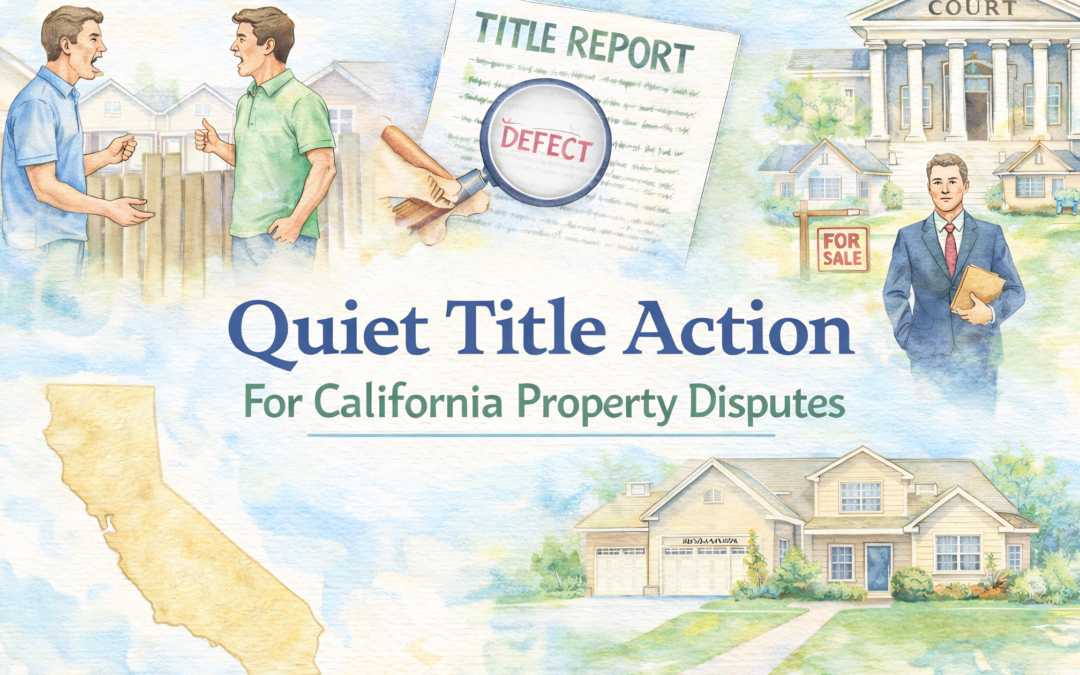
- What Is the Role of a Quiet Title Action in a California Property Dispute?
- When Does a Property Dispute Become a Title Problem?
- What Are the Main Warning Signs That Quiet Title May Be Needed?
- Does the Dispute Involve Competing Ownership Claims?
- Does the Title Report Show a Cloud on Title?
- Does a Boundary Dispute Affect Ownership or Title?
- Does an Easement Claim Create a Title Problem?
- Can Quiet Title Help With Fraudulent, Defective, or Disputed Deeds?
- Can Quiet Title Help With Probate or Inheritance Property Disputes?
- Why Do Sale, Refinance, and Title Insurance Problems Often Trigger Quiet Title Issues?
- When May Quiet Title Not Be the Right Remedy?
- What Evidence Helps Determine Whether Quiet Title Is Needed?
- What Happens If the Title Problem Cannot Be Fixed Voluntarily?
- When Should a Property Owner Seek Legal Guidance?
- Final Takeaway
- Frequently Asked Questions About Quiet Title and California Property Disputes
- Need Help Clarifying a California Property Title Dispute?
Updated on April 29, 2026
A California property dispute does not always require a quiet title action. Some issues can be resolved with a corrective deed, a release, a negotiated agreement, a probate step, or another legal remedy.
But when the dispute creates uncertainty in the title record, affects title insurance, blocks refinancing, or delays the ability to sell the property, the issue may require more than a private fix. In those situations, a court judgment may be needed to determine the parties’ property rights.
The real question is not simply whether there is a property dispute. The question is whether the dispute creates a title problem that cannot be cleared voluntarily.
This guide explains when a California property dispute may require a quiet title action, when another remedy may fit better, and what evidence can help determine the right path forward.
What Is the Role of a Quiet Title Action in a California Property Dispute?
A quiet title action is used to resolve adverse claims to real property and confirm ownership or title interests. In a California property dispute, it becomes relevant when documents, liens, boundaries, ownership history, or claimed rights create title uncertainty that cannot be cleared voluntarily. It is not used for every real estate disagreement; it is mainly relevant when the dispute affects the title record or the legal interests tied to the property.
When Does a Property Dispute Become a Title Problem?
A property dispute becomes a title problem when it creates uncertainty about ownership, recorded title, or another legal interest in the property. This may involve a competing claim, deed issue, boundary conflict, easement dispute, inheritance issue, or another recorded or unrecorded interest affecting title.
Quiet title is more likely to become relevant when the issue cannot be fixed through a signed agreement, corrective deed, release, reconveyance, or other voluntary document. In those situations, a court judgment may be needed to determine the parties’ rights and clear the title.
The need for quiet title often becomes clearer when the dispute affects a sale, refinance, title insurance review, development plan, or possession of the property. If the title problem remains unresolved, quiet title may be one legal path used to resolve it.
What Are the Main Warning Signs That Quiet Title May Be Needed?
Quiet title may become relevant when a property dispute affects ownership, recorded title, marketability, or insurability. The issue becomes more serious when a title problem cannot be cleared through an agreement, correction, release, reconveyance, or other voluntary document.
| Warning Sign | Why It Matters | Quiet Title Relevance |
|---|---|---|
| Someone else claims ownership | Competing ownership claims may leave title legally uncertain. | High |
| A deed appears incorrect, forged, or disputed | The recorded title may not reflect the true ownership interest. | High |
| The title report shows an old lien or unreleased interest | A recorded claim can create a cloud on title and delay a transaction. | High |
| A boundary dispute affects the property line | The dispute may involve ownership of part of the land, not just neighbor conduct. | Medium to High |
| An easement claim affects access or use rights | Unclear easement rights can affect title, development, sale, or refinancing. | Medium to High |
| A sale, refinance, or title insurance review is delayed | Buyers, lenders, or title insurers may require title issues to be resolved first. | High |
| All parties are willing to sign corrective documents | The issue may be resolved without filing a quiet title lawsuit. | Lower |
Does the Dispute Involve Competing Ownership Claims?
A quiet title action may be needed when more than one person or entity claims an ownership interest in the same property. This can happen when the recorded title does not match the parties’ understanding, a prior transfer is disputed, or someone claims that the deed does not reflect the true ownership rights.
Competing ownership claims may arise from family transfers, co-owner disagreements, forged deeds, improperly recorded documents, inheritance disputes, or prior agreements that were never clearly reflected in the property records.
The key issue is whether the dispute affects title. If one party is only disputing payment, possession, or performance under an agreement, another remedy may be more appropriate. But if the dispute creates uncertainty about who owns the property, what percentage each party owns, or whether a recorded interest is valid, quiet title may be used to ask the court to determine the parties’ rights.
Does the Title Report Show a Cloud on Title?
A title report can reveal issues that are not obvious from possession or day-to-day use of the property. Old liens, unreleased deeds of trust, recording mistakes, conflicting deeds, incorrect legal descriptions, or unknown claimants may all create uncertainty about whether title is clear.
A cloud on title matters because it can affect marketability and insurability. Even if the owner believes the issue is outdated or incorrect, a buyer, lender, or title insurer may still treat the recorded claim as a problem until it is released, corrected, or resolved by a court judgment.
A quiet title action may be considered when the title issue cannot be cleared voluntarily. If the claimant cannot be located, refuses to sign a release, or the recorded documents leave ownership uncertain, a quiet title action may be used to ask the court to remove or resolve the cloud on title.
Does a Boundary Dispute Affect Ownership or Title?
A boundary dispute may require more than a simple neighbor discussion when it affects ownership, recorded title, or the legal right to use part of the property. This can happen when a fence, wall, driveway, structure, or survey conflict raises questions about where the property line actually sits.
The issue may call for quiet title when a neighbor claims part of the land, disputes the legal description, or asserts rights based on long-term use. In those situations, the issue is not only about physical use of the property. It may affect the owner’s title, future sale, development plans, or title insurance.
Not every boundary disagreement requires quiet title. If the issue involves temporary access, minor encroachment, or neighbor conduct that does not affect title, another remedy may fit better. But when the dispute creates uncertainty about legal ownership of the land, quiet title may be used to ask the court to determine the parties’ property rights.
Does an Easement Claim Create a Title Problem?
An easement claim can become a title issue when it affects access, use rights, development, sale, refinancing, or title insurance. This may happen when someone claims a right to use a driveway, road, utility path, shared access area, or another part of the property.
The issue becomes more serious when the easement is unclear, disputed, unrecorded, or broader than what the owner believes was allowed. A recorded easement with vague language can also create problems if the parties disagree about location, scope, maintenance, or whether the easement still applies.
Quiet title may be relevant when the easement claim creates uncertainty about property rights that cannot be resolved by agreement or clarification. But if the dispute is only about temporary interference, maintenance, or conduct, a different remedy may be more appropriate.
Can Quiet Title Help With Fraudulent, Defective, or Disputed Deeds?
Quiet title may be needed when a deed creates uncertainty about who owns the property or whether a transfer was valid. This can happen with forged deeds, unauthorized transfers, disputed quitclaim deeds, incorrect legal descriptions, or documents recorded without proper authority.
A defective or disputed deed can create a serious title problem because the public record may not reflect the true ownership rights. Even if the issue seems obvious to the owner, buyers, lenders, and title insurers may still require a formal resolution before treating the title as clear.
Quiet title may be used when the deed issue cannot be corrected voluntarily. If the parties disagree about the transfer, the person who recorded the deed refuses to cooperate, or the defect affects marketable title, a court judgment may be needed to determine the property rights and remove the uncertainty.
Can Quiet Title Help With Probate or Inheritance Property Disputes?
Quiet title becomes more likely when inherited property has unclear or disputed ownership. This can happen when heirs disagree about who owns the property, a prior transfer was never recorded correctly, trust or estate documents conflict with the title record, or a deceased owner still appears in the chain of title.
These disputes often create title problems because buyers, lenders, and title insurers need a clear record of ownership before moving forward. If family members, heirs, beneficiaries, or prior owners appear to have competing claims, the title may remain clouded until the issue is resolved.
Quiet title is not always the first step in an inheritance dispute. Some issues may need to be addressed through probate, trust administration, or corrective documents before a title claim can be resolved. But when the dispute leaves ownership uncertain or creates a cloud on title, quiet title may be used to ask the court to determine the property rights.
Why Do Sale, Refinance, and Title Insurance Problems Often Trigger Quiet Title Issues?
A title issue often becomes urgent when the owner tries to sell, refinance, or insure the property. Even if a dispute has existed for years without immediate conflict, a buyer, lender, escrow officer, or title insurer may require the issue to be resolved before the transaction can move forward.
This can happen when a preliminary title report shows a recorded interest, disputed deed, boundary issue, easement claim, unreleased deed of trust, or another title concern. The title company may exclude the issue from coverage, request additional documents, or require a court judgment before treating the title as clear.
A court judgment may be needed when the problem affects marketable or insurable title and cannot be cleared through a release, reconveyance, corrective deed, or agreement. In that situation, the goal is not just to resolve a private dispute. The goal is to create enough legal certainty for ownership, financing, title insurance, or a future sale.
When May Quiet Title Not Be the Right Remedy?
Quiet title is not the right remedy for every California property dispute. It is usually most relevant when the dispute affects ownership, title, marketability, insurability, or a recorded interest in the property.
Some disputes may be better handled through a different legal path, especially when the issue can be fixed voluntarily or does not affect title.
| Issue | Possible Alternative | Why Quiet Title May Not Fit |
|---|---|---|
| Co-owners disagree about selling the property | Partition action | The issue may involve sale or division of ownership, not a defect in title. |
| A deed contains a correctable clerical error | Corrective deed | If all parties cooperate, the issue may be fixed without a lawsuit. |
| An old lienholder agrees to sign a release | Release or reconveyance | A voluntary release may clear the title without court involvement. |
| Someone temporarily enters or interferes with the property | Trespass claim or injunction | The dispute may involve conduct rather than ownership or title. |
| A buyer or seller breaches a contract | Breach of contract or specific performance claim | The main issue may be contract enforcement, not title ownership. |
| An estate issue remains unresolved | Probate or trust proceeding | Probate or trust administration may need to occur before title can be clarified. |
What Evidence Helps Determine Whether Quiet Title Is Needed?
The evidence needed for a quiet title action depends on the type of property dispute. The main goal is to understand whether the issue affects ownership, recorded title, marketability, insurability, or another legal interest in the property.
In many cases, the most useful evidence includes deeds, title reports, surveys, lien records, trust or probate documents, and written communications showing that another party claims an interest in the property.
| Evidence | Why It Matters |
|---|---|
| Grant deed or quitclaim deed | Shows the recorded ownership history and any disputed transfer. |
| Preliminary title report | Identifies recorded liens, easements, deeds of trust, exceptions, and title defects. |
| Legal description | Confirms the exact property being disputed. |
| Survey | Helps evaluate boundary, encroachment, or property line issues. |
| Deed of trust or reconveyance | Shows whether a loan interest remains recorded or was properly released. |
| Probate or trust documents | Helps clarify inheritance, transfer authority, or estate-related ownership issues. |
| Tax records | May support or conflict with ownership, possession, or payment history. |
| Written communications with claimants | Shows competing claims, refusal to release interests, or attempts to resolve the issue. |
What Happens If the Title Problem Cannot Be Fixed Voluntarily?
If a title problem cannot be resolved through a release, reconveyance, corrective deed, agreement, or other voluntary document, the dispute may need a court judgment. This is often the point where a quiet title action becomes more relevant.
Before filing, the parties usually need to identify the recorded and unrecorded interests affecting the property. This may include known claimants, unknown claimants, lienholders, heirs, easement holders, prior owners, or anyone else who may claim a legal interest in the property.
A quiet title action can then ask the court to determine the parties’ rights and resolve the title uncertainty. If the court enters a judgment, that judgment may help clarify ownership, remove invalid claims, and create a cleaner title record for future sale, refinancing, or title insurance review.
When Should a Property Owner Seek Legal Guidance?
A property owner should consider legal guidance when a title issue cannot be corrected through ordinary documents or cooperation from the other party. This is especially important when the dispute affects ownership, title insurance, refinancing, escrow, development, or possession of the property.
Legal guidance may be useful if a title company will not insure the property, a sale or refinance is delayed, a neighbor claims ownership or access rights, a deed appears incorrect, or multiple parties claim rights in the same property.
It may also be important when unknown claimants need to be addressed. In those situations, the issue may require more than a private agreement because a court judgment may be needed to bind the parties and clear the title record.
Final Takeaway
Not every California property dispute requires a quiet title action. The issue usually becomes a quiet title matter when it affects ownership, recorded title, marketability, title insurance, or the ability to sell or refinance the property.
If the problem can be fixed through a release, corrective deed, reconveyance, agreement, probate step, or another remedy, quiet title may not be the first option. But when the dispute creates a cloud on title that cannot be cleared voluntarily, a quiet title action may be the legal tool used to ask the court for a binding decision.
The practical question is whether the dispute creates uncertainty in the title record. If it does, the next step is usually to review the documents, identify the competing claims, and determine whether a court judgment is needed to clear the issue.
Frequently Asked Questions About Quiet Title and California Property Disputes
Does every California property dispute require a quiet title action?
No. Quiet title is usually relevant when a dispute affects ownership, recorded title, marketability, title insurance, or another legal interest. Some issues may be resolved through corrective documents, releases, probate steps, or other remedies.
Can a quiet title action remove an old lien?
Yes. A quiet title action may help remove an old or invalid lien when it continues to cloud title and cannot be cleared through a release, reconveyance, or voluntary correction.
Can a boundary dispute require quiet title?
Yes, but only when the boundary dispute affects ownership, title, or the legal right to use part of the property. If the issue is only temporary interference or neighbor conduct, another remedy may be more appropriate.
Can quiet title resolve an easement claim?
Yes. Quiet title may resolve an easement claim when disputed access, use rights, or recorded easement language creates uncertainty about property rights or title.
Is quiet title the same as partition?
No. Quiet title resolves disputed ownership or title interests. Partition usually applies when co-owners need to divide, sell, or separate their interests in the property.
Can quiet title help before selling or refinancing property?
Yes. If a title defect, lien, deed issue, boundary dispute, easement claim, or adverse claim prevents clear title, financing, escrow, or title insurance, quiet title may help resolve the issue.
Need Help Clarifying a California Property Title Dispute?
If a California property dispute has created uncertainty in the title record, legal guidance can help determine whether the issue can be resolved voluntarily or whether a quiet title action may be needed. Schorr Law handles real estate disputes involving title defects, competing claims, liens, easements, boundaries, and other quiet title claims affecting property rights.
About the Author

Zachary D. Schorr is a California real estate litigation attorney and the founding attorney of Schorr Law. He represents clients in specific performance actions, partition lawsuits, quiet title disputes, and complex real estate litigation throughout Southern California.
📍 Schorr Law
Call Us: (866) 999-2990
📧 zschorr@schorr-law.com
Full Bio | Contact | Instagram | View All Articles
Call Us
Phone: (866) 787-9384
Email: info@schorr-law.com
Address: 1901 Avenue of The Stars, Suite 615, Los Angeles, California 90067
Text: (833) 249-1634