

Updated on May 5, 2026
Prescriptive Easements in California: What Neighbors Need to Know
What Is a Prescriptive Easement?
Prescriptive easement California law allows someone to gain legal use of another person’s property after five years of continuous, open, and unauthorized use. Think of it as the easement equivalent of adverse possession minus the property tax requirement. The critical distinction is that a prescriptive easement grants only the non-exclusive right to use a portion of the property in a specific way, not ownership of the land itself.
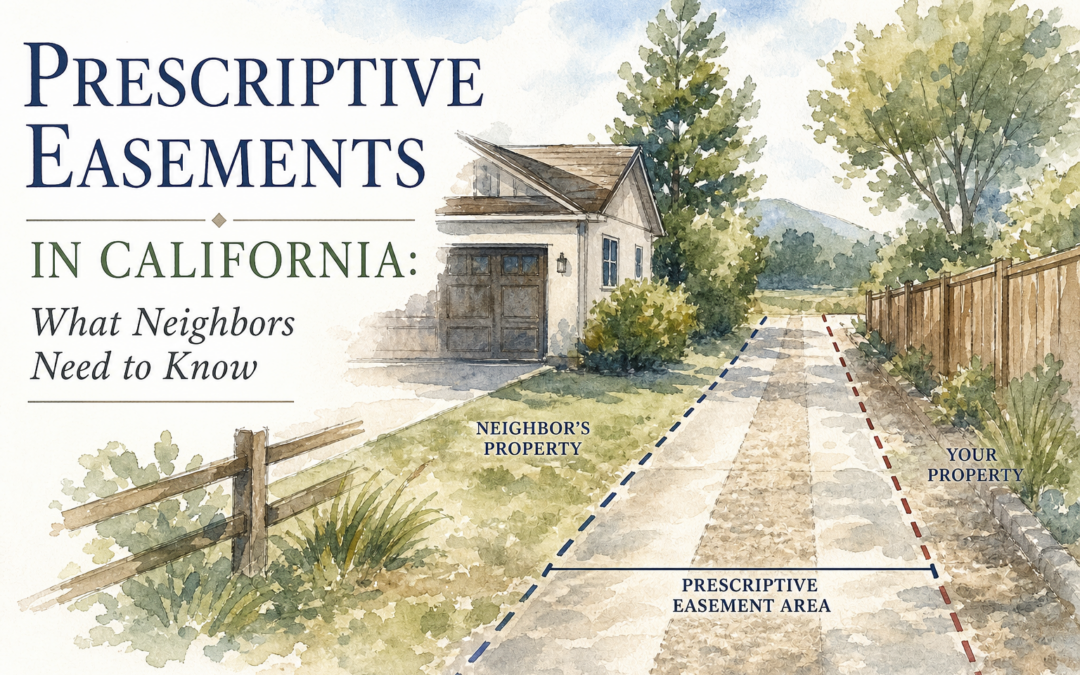
Common examples in California include a neighbor who has cut across a corner of an adjoining property to reach a road for years, a hiking trail that the public has used across private land without the owner’s knowledge, or an encroaching driveway that straddles a property line. In Los Angeles, the most frequent prescriptive easement we see is where the original developer built a driveway with a portion on the neighbor’s property.
Once a court confirms a prescriptive easement, it runs with the land. That means the right can be transferred when the benefiting property is sold, and it burdens the servient property indefinitely, even after a change in ownership. Our Schorr Law attorneys have extensive experience with this, and we typically either settle the case with a grant of easement or take it to trial and get a quiet title judgment that we can record.
The Legal Elements a Claimant Must Prove
Under California law, a person seeking to establish a prescriptive easement must prove each of the following elements by clear and convincing evidence. All elements must be satisfied for the claim to succeed.
The Five Elements of a Prescriptive Easement in California
- Open and Notorious Use. The use must be visible and obvious, not hidden or concealed. The landowner must have had reasonable opportunity to observe it. The point being is that the action is obvious to the owner.
- Hostile and Adverse Use. The use must occur without the owner’s permission. This element is sometimes called “under claim of right.” If the owner grants a license, the use is no longer hostile and the prescriptive period resets. That said, if the 5 year prescriptive period has passed, simply granting the permission after the right has accrued does no good.
- Continuous and Uninterrupted Use. The use must be reasonably continuous for the statutory period. The standard is what a similarly situated person would reasonably do with that type of easement, not literal daily use.
- Actual Use. The claimant must have actually used the property in the manner claimed, not merely planned to or intended to.
- Statutory Period of Five Years. All of the above elements must be maintained for at least five consecutive years. Under Code of Civil Procedure section 321, this five-year period is the standard prescriptive period for easements in California.
California courts have interpreted these elements in a variety of fact-intensive ways over the decades. The “hostile” element, for example, does not require any animosity between neighbors. It simply means the use occurred without authorization. A perfectly friendly neighbor who crosses your land every day without your permission is acting hostilely in the legal sense of the word. If there is silence or an absence of permission, then the law presumes hostility. The owner of the land cannot just sit on their hands.
One of the most important things to understand is that permission defeats a prescriptive easement claim. A simple written or verbal license given to a neighbor can prevent a prescriptive easement from ever forming. This is why a landowner’s response to a neighbor’s use of their property can have lasting legal consequences.
Why Permission Is the Landowner’s Best Defense
California law offers landowners a straightforward tool to prevent prescriptive easements from arising: grant permission. If use is permissive, it cannot be hostile, and without hostility, no prescriptive easement can form. Many landowners unknowingly allow their neighbors to use their property in ways that could eventually ripen into prescriptive easements simply because they never address the situation in writing.The safest approach is a written license agreement that explicitly states the neighbor’s use is permissive and may be revoked at any time. Or, post a sign granting permission. A simple license or permission, unlike an easement, does not run with the land and can generally be terminated by the landowner. By documenting the permissive nature of the use, the landowner preserves the right to revoke access in the future and prevents the neighbor from building a prescriptive easement claim.
Some California landowners post signs along their property boundaries stating that use is by permission of the owner and does not constitute a right. While signs alone do not guarantee protection in every situation, they are a low-cost step that can bolster a landowner’s position if litigation arises.
How a Landowner Can Block a Prescriptive Easement Before It Matures
If a landowner discovers that a neighbor is using their property in an open, continuous, and unauthorized manner, time is of the essence. There are several steps a landowner can take to interrupt the five-year prescriptive period before it runs. Physical interruption is one option. If a landowner installs a fence, gate, or other barrier that prevents the unauthorized use, the prescriptive period stops. However, if the neighbor successfully avoids the barrier and continues use, a court may find that the interruption was insufficient. The interruption must actually prevent the use.
Filing a civil action can also interrupt the statutory period. A lawsuit for trespass or to quiet title signals to a court that the landowner actively asserted rights against the claimant, which defeats the continuity required for a prescriptive easement.
Perhaps most importantly, a landowner who sends a cease-and-desist letter and documents the neighbor’s trespass preserves evidence of the owner’s objection. That documentation becomes critical if the case proceeds to litigation.
Public Use and the Prescriptive Easement Problem
Private property owners in California face a particular challenge when the public, rather than a single neighbor, uses their land. Trails, beach access paths, and informal walkways that cross private property can give rise to prescriptive easements claimed by the public or by a governmental entity.
Under California law, a public entity or a group of members of the public can establish a public prescriptive easement over private land. The elements are largely the same as for private prescriptive easements, but the scope of the potential burden is obviously much greater. A trail that has been hiked for five years across private land could result in a public right of access that the owner cannot unilaterally close.
Landowners facing this situation should consult a California real estate attorney immediately. Posting signs, closing access during certain periods, and documenting efforts to exclude the public are all important steps that should be taken as soon as possible.
Prescriptive Easement vs. Adverse Possession: Understanding the Difference
These two doctrines are often confused, but they produce very different legal outcomes. Adverse possession, when successfully established, transfers title to a portion of land from one owner to another. A prescriptive easement, by contrast, grants only the right to use the land in a specific way. The underlying title never changes hands.
The elements of adverse possession in California include payment of property taxes on the disputed area for the statutory period, which is a requirement that does not apply to prescriptive easements. This distinction often makes prescriptive easement claims more viable than adverse possession claims, since a claimant does not need to have paid taxes on the property to establish the easement. Both doctrines share the five-year statutory period and the requirements of open, notorious, hostile, and continuous use. If you are dealing with a boundary dispute or an encroachment by a neighbor, a real estate attorney can help determine which doctrine, if either, is implicated.
What to Expect If a Prescriptive Easement Dispute Goes to Court
Prescriptive easement cases are intensely fact-specific. Courts examine the nature and frequency of use, the extent of the claimed easement, whether the use was visible to the landowner, and whether the landowner ever took steps to interrupt or object to the use. Evidence such as photographs, surveys, witness testimony from neighbors, and historical records all play a significant role.
The claimant bears the burden of proving every element of the prescriptive easement by clear and convincing evidence, which is a higher standard than the ordinary preponderance of the evidence used in most civil cases. That said, a claimant who can produce credible evidence of five or more years of open, hostile, and continuous use will present a formidable claim.
Landowners defending against a prescriptive easement claim should focus on any evidence that the use was permissive, interrupted, concealed, or inconsistent. Evidence that the claimant asked permission at any point during the five-year period can be particularly powerful, since it implies the claimant recognized that the use was not a matter of right.
Prescriptive easement cases do hold a right to a jury trial. At Schorr Law, we have actually tried a prescriptive easement case to a successful outcome at a jury trial. This is rare, but it does happen and we have experience with it. Our attorneys engaged in a trial over a shared driveway in mid-city Los Angeles, and won.
Key Takeaways
- A prescriptive easement requires five years of open, hostile, continuous, and actual use without permission.
- Granting written permission is the single most effective way to prevent a prescriptive easement from forming.
- Once confirmed by a court, a prescriptive easement runs with the land and binds future owners.
- Time is critical. If you suspect a prescriptive easement is forming on your property, act before the five-year period expires.
Frequently Asked Questions About Prescriptive Easements
The following questions come up regularly in our practice. The answers below are general explanations. The specifics of any easement dispute depend on the facts, and a consultation with a California real estate attorney is always the appropriate next step.
How long does it take to acquire a prescriptive easement in California?
California law requires five years of continuous, open, hostile, and actual use without the landowner’s permission before a prescriptive easement can be established. This five-year period comes from Code of Civil Procedure section 321. It is worth emphasizing that the clock does not start over simply because a new owner buys the burdened property. Successive periods of qualifying use by different claimants can sometimes be combined, a concept courts refer to as “tacking.”
Can a prescriptive easement be stopped once it starts forming?
Yes, but the landowner must act before the five-year prescriptive period expires. The most reliable methods are granting written permission (which converts the hostile use into a permissive one and resets the clock), physically blocking access with a fence or gate, or filing a civil action for trespass. Any of these steps, properly documented, can interrupt the running of the prescriptive period. Waiting is the most common mistake landowners make, and it can be very difficult to undo.
Does a prescriptive easement transfer when the property is sold?
Yes. Once a court confirms a prescriptive easement, it runs with the land on both sides. The easement continues to burden the property subject to it, even if that property is sold, and it continues to benefit the property that holds the right, even if that property is sold. A new owner who purchases a property encumbered by a prescriptive easement generally takes the property subject to it. This is one reason a thorough title search and property survey are essential before any California real estate purchase. If the prescriptive easement claim has matured but not been perfected through a lawsuit or settlement then the concept of “tacking” applies and the new owner can still pursue the prescriptive easement based on the prior owner’s history of use.
What is the difference between a prescriptive easement and adverse possession?+
Adverse possession transfers title to a portion of land. A prescriptive easement grants only the right to use that land in a specific, defined way. The underlying ownership never changes with a prescriptive easement. Adverse possession in California also requires the claimant to have paid property taxes on the disputed area for the statutory period, a requirement that does not apply to prescriptive easement claims. As a practical matter, prescriptive easement claims tend to be more common in neighbor disputes because the tax-payment requirement for adverse possession is harder to satisfy.
Does a neighbor have to pay anything to obtain a prescriptive easement?
No. A prescriptive easement is acquired through long-term use, not through payment or negotiation. The claimant owes the burdened landowner nothing. This is one of the aspects of the doctrine that most surprises property owners. A neighbor can essentially acquire a permanent right to use a portion of your land without ever compensating you, simply by using it openly and without permission for five years. That is precisely why early intervention is so important.
Moreover, if a lawsuit arises, neither party has the right to seek to recover their attorneys’ fees as a part of the lawsuit. This means the owner who has a prescriptive easement case against them gets to pay for the cost of defense whether they win or lose and may end up with their land burdened by an easement without any compensation for the same – this can be expensive.
Can the public acquire a prescriptive easement over private land in California?
Yes. California courts recognize public prescriptive easements where members of the public have used private land openly, continuously, and without permission for at least five years. This is a significant concern for landowners whose property includes informal hiking paths, beach access routes, or other corridors that have been used by the public over time. A governmental entity can also assert a public prescriptive easement on behalf of the public. Landowners facing this situation should post signs and document their efforts to exclude unauthorized users without delay.
What evidence does a court look at in a prescriptive easement case?
Courts consider photographs, aerial images, surveys, maps, and any physical evidence of use such as worn pathways, tire tracks, or maintained landscaping. Witness testimony from neighbors, former owners, and anyone who observed the use during the claimed prescriptive period is often decisive. Written correspondence, particularly any letter or email in which one party asked for or granted permission, can significantly affect the outcome. Evidence that the claimant acknowledged needing permission at any point during the five-year period is particularly damaging to a prescriptive easement claim.
Speak with a California Prescriptive Easement Attorney
Prescriptive easements arise quietly, and by the time most property owners realize there is a problem, significant legal rights may already be at stake. Whether you are a landowner concerned that a neighbor’s use of your property is approaching the five-year mark, or you believe you have acquired a prescriptive easement over an adjacent parcel, the attorneys at Schorr Law can help you evaluate your options and protect your interests.
Schorr Law focuses exclusively on California real estate law and has extensive experience litigating and resolving easement disputes throughout the state. Contact our office to schedule a consultation.
About the Author
Zachary D. Schorr is a California real estate litigation attorney and the founding attorney of Schorr Law. He represents clients in specific performance actions, partition lawsuits, quiet title disputes, and complex real estate litigation throughout Southern California.
📍 Schorr Law
Call Us: (866) 999-2990
📧 zschorr@schorr-law.com
Full Bio | Contact | Instagram | View All Articles
This article is intended for general informational purposes only and does not constitute legal advice. Reading this post does not create an attorney-client relationship with Schorr Law, APC. Every real estate matter involves unique facts and circumstances. Please consult a qualified California real estate attorney regarding your specific situation.