

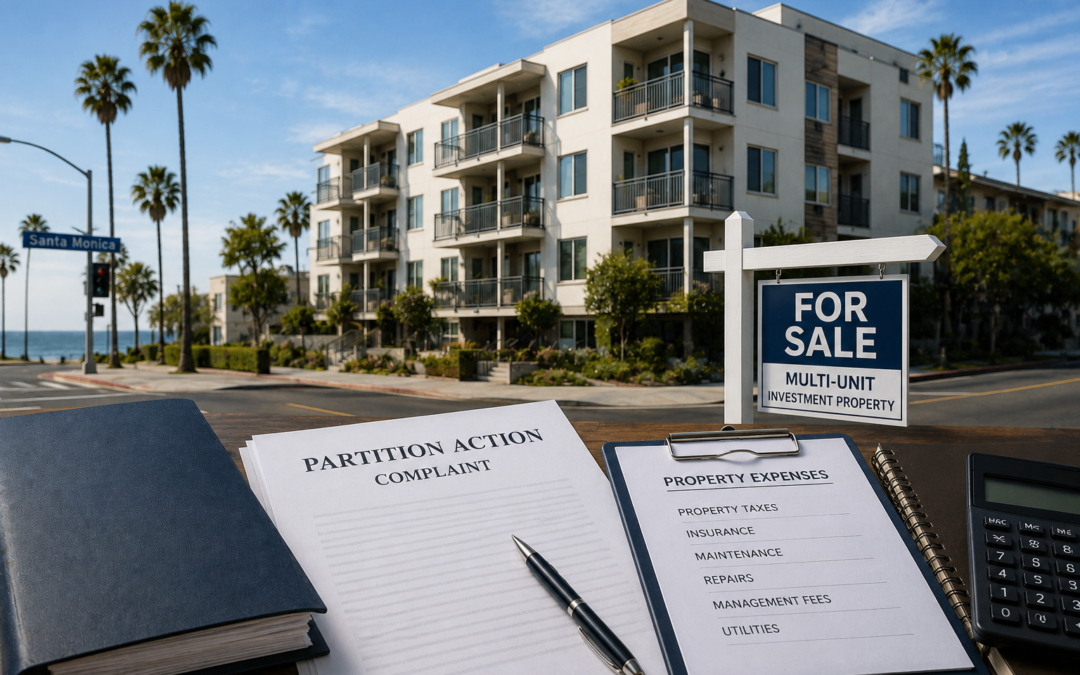
Partition of a Santa Monica Apartment Building: Trust vs. Co-Owner Dispute
This was a case we handled in Santa Monica involving a multi-unit apartment building owned by a trust and an individual. The trust needed to sell the property. The reason was simple. The sale was necessary to fund the beneficiary’s long-term care. The problem was the co-owner dispute. They were not cooperating, not contributing to expenses, and not willing to move forward with a sale. That is when Schorr Law got involved.
Because the property was co-owned, the dispute could not be solved by one side simply deciding to sell. It required a legal path to address the blocked sale, unpaid ownership expenses, and the trust’s need to move forward for the beneficiary.
What the Santa Monica Co-Owner Dispute Came Down To?
The situation was not complicated on paper. The trust needed liquidity. The co-owner was blocking that from happening. At the same time, the co-owner was not paying their share of the property expenses.
At its core, the dispute involved a blocked sale, unpaid property expenses, and a trust that needed to move forward for the beneficiary.
The key issues were:
- Whether the property could be sold
- Whether one party could block the sale
- How unpaid expenses would be handled
- What to do about the defendant’s lack of participation
The case reached a point where it could not be resolved without court involvement.
Why Filing a Partition Action Became Necessary?
We attempted to move things forward without litigation, but that was not going to work. At that point, filing a partition action was necessary.
It allowed us to:
- Force the sale of the apartment building
- Address the lack of contribution from the co-owner
- Move the trust toward resolving its obligations
- Address who the court will handle the defendant’s lack of participation including who would sign documents and participate with the sale.
Without that step, the property would have remained tied up while the trust continued to carry the burden.
In this kind of case, partition is not just about ending co-ownership. It can also create a court-supervised process for sale authority, contribution issues, and participation problems when one side refuses to cooperate.
Property Expense and Co-Owner Contribution Issues
A big part of the case involved the fact that one side was not paying its share.
That included:
- Property taxes
- Maintenance and repairs
- Insurance
- Ongoing management costs
In these situations, the court can account for that when the property is sold. It affects how the proceeds are ultimately divided.
That accounting process matters because one co-owner’s failure to contribute can affect reimbursement, offsets, and the final distribution of sale proceeds.
Why Trust-Owned Property Disputes Can Become Urgent?
This was not just a typical co-ownership dispute. The trust had obligations. Delaying the sale directly impacted the beneficiary.
That added urgency to the case and required a clear strategy to move things forward.
When trust property is tied up by a noncooperating co-owner, the dispute can affect more than ownership rights. It can also affect the trustee’s ability to preserve trust assets and act for the beneficiary’s benefit.
Final Takeaway on Trust Property and Partition by Sale
Even when a trust is involved, one co-owner cannot hold up a property indefinitely. If there is no agreement, partition is often the only way to resolve the situation and allow the sale to move forward.
In cases involving trust-owned real estate, beneficiary needs, and a noncooperating co-owner, the goal is not just to end ownership. It is to create a court-supervised path for sale, accounting, and distribution of the property interests.
FAQs About Co-Owner Disputes & Partition in California
Can a trust force the sale of co-owned property in California?
Yes. If a trust co-owns real estate and liquidation is necessary to fulfill trust obligations, the trustee may file a partition action to seek a court-ordered sale. California partition law allows certain co-owners or property interest holders to commence a partition action.
What happens if a co-owner refuses to pay property expenses?
Courts may order reimbursement, offsets, or equitable adjustments during the accounting phase of a partition lawsuit. This can include unpaid shares of property taxes, insurance, maintenance, repairs, or other ownership expenses.
Is partition available for apartment buildings?
Yes. Multi-unit residential properties, including apartment buildings, can be subject to partition by sale when co-owners cannot agree on sale, ownership, or management.
Do trustees have special obligations in co-ownership disputes?
Yes. Trustees must act for the benefit of the beneficiaries and take reasonable steps to preserve trust property. If a co-owned property is tied up by a noncooperating owner, the trustee may need to pursue legal remedies to protect the trust’s interests.
Can rental income be divided during partition litigation?
Yes. Courts may allocate rental income and adjust distributions based on each party’s contributions, expenses, and management participation during the partition case.
Dealing With a Co-Owned Property Dispute in Santa Monica or Los Angeles County?
If you are dealing with a co-owner who is not cooperating, or a situation where a property needs to be sold but cannot move forward, there are legal options to resolve it.
Schorr Law handles partition actions and co-ownership disputes throughout Los Angeles County.
About the Author

Zachary D. Schorr is a California real estate litigation attorney and the founding attorney of Schorr Law. He represents clients in specific performance actions, partition lawsuits, quiet title disputes, and complex real estate litigation throughout Southern California.
📍 Schorr Law
Call Us: (866) 999-2990
📧 zschorr@schorr-law.com