

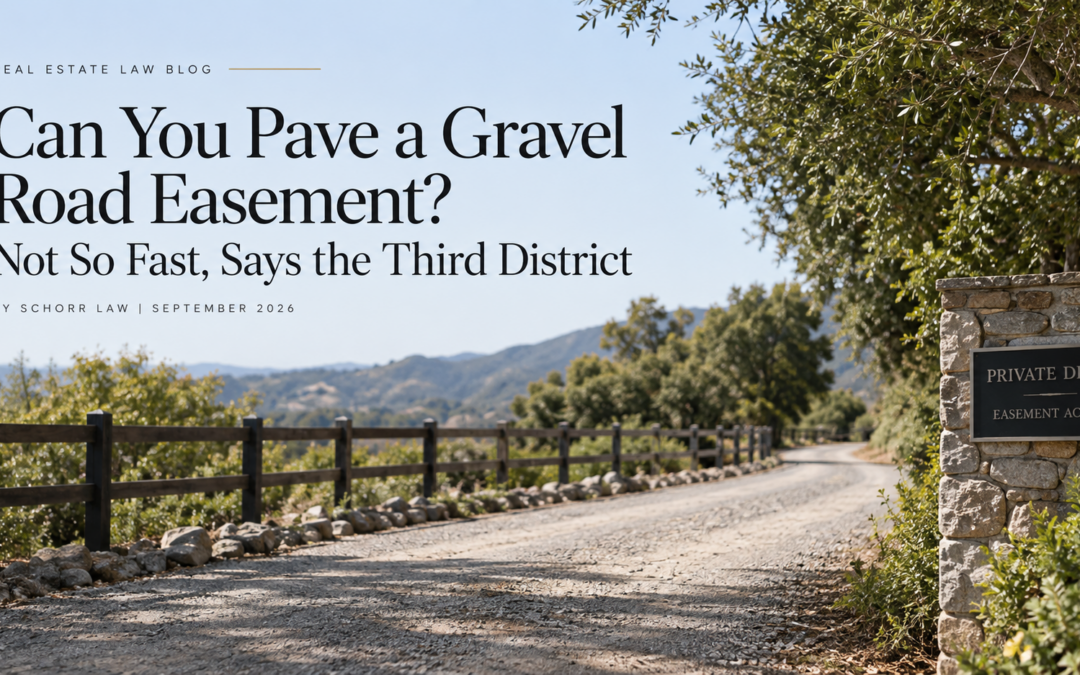
- Paving a Gravel Driveway
- Bernstein v. Sebring: Neighbors, a Gravel Driveway, and a Paving Plan
- Why the Gravel Driveway Paving Dispute Was Not Barred by the First Lawsuit?
- Secondary Easement Rights and Paving a Gravel Road in California
- Gravel Driveway Maintenance vs. Paving or Asphalt Improvements
- Before Paving a Gravel Road or Driveway Easement in California
- What California Property Owners Should Know Before Paving a Gravel Road Easement?
Updated on September 25, 2026
Paving a Gravel Driveway
If you hold an easement over someone else’s property for road access, you might assume you can improve that road however you see fit, including paving it. A recent California appellate decision says otherwise.
In Bernstein v. Sebring, 116 Cal.App.5th 1264 (2025), the Third District Court of Appeal held that a dominant owner’s road easement does not automatically include the right to pave a gravel road. The decision reinforces a core principle of California easement law: secondary easement rights are governed by a rule of reason, not by assumption.
That means the right to use a roadway easement for ingress and egress does not necessarily include the right to make every proposed improvement to the roadway. Whether paving falls within the easement depends on the nature of the easement, how it was created, and the facts and circumstances surrounding its use. Those distinctions can also vary depending on the type of easement involved.
The decision is particularly relevant to disputes involving road access, shared driveways, gravel or dirt roads, and rural or semi-rural ingress and egress rights in California. Property owners facing a dispute over the scope or use of an access easement may also benefit from reviewing Schorr Law’s broader guidance on easement disputes in California.
Bernstein v. Sebring: Neighbors, a Gravel Driveway, and a Paving Plan
The facts of Bernstein v. Sebring are straightforward.
Plaintiff Scot Bernstein and defendant Tim Sebring owned adjoining properties within the same subdivision.
Sebring’s property had an easement on Bernstein’s property for ingress and egress, which included portions of a paved road running through the subdivision and a 244.5-foot gravel/dirt roadway that served as a driveway to Sebring’s property.
This was the second lawsuit between the parties.
The first case involved Sebring clearing trees and performing construction on the easement without Bernstein’s permission. That case settled.
Bernstein then filed a second action — this time seeking a declaratory judgment to prevent Sebring from paving the gravel portion of the easement road.
The trial court denied Sebring’s motion for judgment on the pleadings, held a bench trial, and found in favor of Bernstein. The court concluded that paving the driveway was “not reasonably necessary to make it available for safe and convenient vehicular travel” and enjoined Sebring from paving.
Sebring appealed, arguing that
- the second suit was an improper splitting of actions, and
- his easement right necessarily includes the right to pave as a matter of law.
The Third District Court of Appeal rejected both arguments and affirmed the judgment.
Why the Gravel Driveway Paving Dispute Was Not Barred by the First Lawsuit?
Sebring’s first argument was procedural. He contended that the paving dispute should have been litigated in the parties’ first case and that Bernstein’s second lawsuit improperly split a cause of action and was therefore barred by res judicata.
The court disagreed.
Under California’s “primary right theory,” a cause of action is composed of
- a primary right held by the plaintiff;
- a corresponding primary duty of the defendant, and
- a wrongful act by the defendant constituting a breach of that duty.
The most important feature of a primary right is that it is indivisible — violation of a single primary right gives rise to only one cause of action.
But here, the court found the two suits involved distinct episodes of alleged violation.
The first case involved Sebring cutting down trees and building a rock wall on the easement — a completed act of interference with Bernstein’s property rights.
The second case involved Sebring’s proposed paving of the gravel road — a different episode entirely that had not yet occurred when the first suit was filed.
Because each suit was based on a separate wrongful act, there was no improper splitting.
Why This Matters in Recurring Easement Disputes?
This holding is a useful reminder that res judicata does not bar subsequent suits involving the same easement if the alleged violations are distinct episodes.
Easement disputes tend to be recurring — the same neighbors fighting over the same strip of land for different reasons over time. Bernstein confirms that each new dispute over the scope of use may give rise to its own cause of action.
For broader context on the kinds of conflicts that can arise over access and use rights, see Schorr Law’s overview of easement disputes.
Secondary Easement Rights and Paving a Gravel Road in California
The heart of the appeal — and the most instructive part of the opinion for California real estate practitioners — is the court’s analysis of secondary easement rights.
For a broader explanation of the underlying property interest, see Schorr Law’s guide to what an easement is.
What Secondary Easement Rights Can Allow on a Gravel or Dirt Road?
Every easement includes what are called “secondary easements” — the right to do such things as are necessary for the full enjoyment of the easement itself. (Dolnikov v. Ekizian (2013) 222 Cal.App.4th 419, 428.)
This can include the right to make repairs, renewals, and replacements on the servient property, and to make changes to the surface of the land “as are necessary to make it available for travel in a convenient manner.” (Id.)
But these incidental or secondary rights are not unlimited.
They are governed by a rule of reason: “there are no absolute rules of conduct. The responsibility of each party to the other and the ‘reasonableness’ of use of the property depends on
- the nature of the easement,
- its method of creation,
- and the facts and circumstances surrounding the transaction.” (Dolnikov, at pp. 428–429.)
That means the scope of a secondary right cannot be determined in the abstract. The analysis depends on the particular easement and the specific improvement being proposed.
The method of creation can also matter because California recognizes different forms of easements, including express, implied, prescriptive, and necessity easements. Schorr Law discusses those distinctions in its overview of different types of easements.
In Bernstein, that rule of reason became the framework for deciding whether Sebring’s right of access also included the right to pave the existing gravel roadway.
A Road Easement Does Not Automatically Mean a Paved Gravel Driveway
Sebring’s central argument was definitional: he pointed to dictionary definitions of the word “road” and argued that because a road can be paved, his easement over a “road” necessarily included the right to pave it.
The court rejected this outright, identifying the logical fallacy: “because a road can be paved does not necessarily mean all roads are paved.” The court noted that declaring all road easements necessarily include the right to pave would “directly contradict established law that the scope of secondary easement rights depends on the circumstances of each easement.”
Whether Sebring’s specific easement included the right to pave was a factual question — not a legal one to be resolved by dictionary.
That distinction is important because a roadway easement identifies the right of access, but it does not by itself resolve every question about the surface, maintenance, or physical alteration of the route. Schorr Law discusses the broader scope of access rights in its overview of right-of-way through private property in California.
In Bernstein, the court therefore looked beyond the label attached to the roadway and focused instead on whether paving was reasonably necessary for the easement’s intended use.
When Is Paving Over a Gravel Driveway “Necessary for Convenient Use”?
Sebring also argued that the trial court applied the wrong standard.
He contended the proper test was whether paving was “necessary for convenience, not necessary for actual use,” and that paving obviously satisfied this standard because travel over a paved surface is more convenient than travel over gravel.
The court corrected the framing:
“Whether one improvement is more convenient than another is the wrong analysis. What matters is whether the proposed improvement is necessary for the convenient use of the easement.”
This is a critical distinction. The question is not whether paving would make the road better — it is whether paving is necessary to make the easement usable for its intended purpose: safe and convenient vehicular travel.
The trial court found, based on the evidence at trial, that paving was not reasonably necessary. And because Sebring did not challenge the sufficiency of the evidence supporting that finding on appeal, the ruling stood.
This standard is especially important in disputes over road access because maintenance and improvement questions often turn on the condition and use of the existing easement rather than on whether a different surface would be preferable. Schorr Law discusses related maintenance issues in its guide to easement maintenance responsibilities.
Why This Distinction Matters?
This holding has significant implications for easement disputes across California, particularly in rural and semi-rural areas where gravel roads, unpaved driveways, and dirt access roads are common.
A dominant owner cannot simply decide to “upgrade” an easement road and force the servient owner to accept permanent changes to their property. Any proposed improvement must clear the “necessary for convenient use” bar — and that determination is inherently fact-specific.
Gravel Driveway Maintenance vs. Paving or Asphalt Improvements
The thread running through the entire Bernstein opinion is the principle that reasonableness governs all secondary easement rights. There are no bright-line rules. Whether a particular use of an easement is reasonable — and whether a proposed improvement falls within the dominant owner’s secondary rights — depends on:
- The nature of the easement (road access, utility, drainage, etc.)
- The method of creation (express grant, prescription, implication, necessity)
- The facts and circumstances surrounding the transaction
Because reasonableness is inherently fact-dependent, whether a particular use constitutes unreasonable interference is a question of fact for the trier of fact — not a question of law to be resolved on the pleadings or by resort to a dictionary.
The same principle also explains why the type and origin of the easement matter. Schorr Law discusses those distinctions in more detail in its guide to when easement type matters in California.
Whether a proposed use amounts to unreasonable interference is generally a factual question for the trier of fact. In Bernstein, that meant the trial court’s finding that paving was not reasonably necessary became central to the outcome.
The broader lesson is that the scope of an easement is determined not only by what the easement allows in theory, but also by how the proposed use relates to the easement’s purpose, history, and surrounding circumstances.
Before Paving a Gravel Road or Driveway Easement in California
1. An easement to use a road does not mean an easement to change the road.
Dominant owners have the right to use the easement for its intended purpose, but proposed modifications, paving, grading, widening, installing drainage — must be necessary for convenient use, not merely more convenient.
2. The reasonableness standard is case-specific.
The same improvement might be permissible in one context and impermissible in another.
A gravel road serving as the sole access to a remote property might warrant paving; the same gravel driveway in a subdivision with other paved access might not. Facts matter.
3. Servient Owners Can Challenge Improvements That Exceed the Easement
If a dominant owner proposes changes to an easement that exceed what is necessary for its convenient use, the servient owner has standing to seek declaratory and injunctive relief — as Bernstein did here.
4. Recurring easement disputes are not barred by res judicata.
Each distinct episode of alleged easement misuse can give rise to its own cause of action. Settling one dispute does not give the dominant owner a free pass for future overreach.
5. Build the factual record.
Because the scope of secondary easement rights turns on reasonableness, and reasonableness is a factual determination, both sides should focus on building a strong evidentiary record at trial.
In Bernstein, the trial court’s factual finding that paving was not reasonably necessary was dispositive — and Sebring’s failure to challenge the sufficiency of the evidence on appeal left him with no remedy.
What California Property Owners Should Know Before Paving a Gravel Road Easement?
Bernstein v. Sebring is a valuable addition to California’s easement jurisprudence. It reinforces that secondary easement rights are not a blank check — they are bounded by reason, context, and necessity.
For property owners and practitioners alike, the case is a reminder that the scope of an easement is not determined by what could be done, but by what is reasonably necessary to be done.
Disputes over paving can also overlap with broader questions involving access rights, maintenance, interference, and the physical scope of an easement. Schorr Law provides additional guidance on California easement disputes and represents property owners in real estate litigation involving the use and scope of easement rights.
If you are dealing with an easement dispute — whether over road access, improvements, or scope of use — contact Schorr Law for a consultation.
About the Author

Zachary D. Schorr is a California real estate litigation attorney and the founding attorney of Schorr Law. He represents clients in specific performance actions, partition lawsuits, quiet title disputes, and complex real estate litigation throughout Southern California.
📍 Schorr Law
Call Us: (866) 999-2990
📧 zschorr@schorr-law.com
Full Bio | Contact | Instagram | View All Articles
Call Us
Phone: (866) 787-9384
Email: info@schorr-law.com
Address: 1901 Avenue of The Stars, Suite 615, Los Angeles, California 90067
Text: (833) 249-1634