

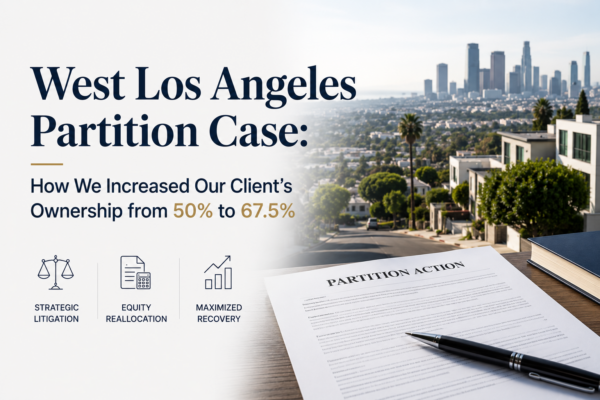
West Los Angeles Partition Case: Increasing Ownership from 50% to 67.5%
This West Los Angeles partition case demonstrates that partition litigation can involve much more than forcing the sale of property. In a Brentwood-adjacent ownership dispute handled by Schorr Law, a brother and sister held title to residential property as 50/50 co-owners. On paper, their interests appeared equal. The financial realities, possession history, and legal claims told a different story.
Through strategic litigation involving partition accounting and a title-based adverse-possession theory arising from a co-tenant ouster, Schorr Law increased our client’s recognized interest in the outcome from 50% to 67.5%. That change significantly altered the equity distribution before sale and produced a materially better result for our client.
Case Result at a Glance
| Issue | Case Detail |
|---|---|
| Location | West Los Angeles / Brentwood-adjacent residential property |
| Relationship | Brother and sister co-ownership dispute |
| Starting point | Record title reflected a 50/50 ownership structure |
| Core dispute | Unequal contributions, possession history, accounting issues, and an alleged co-tenant ouster |
| Legal strategy | Partition, accounting, and an adverse-possession/title-based argument |
| Result | Client’s recognized interest increased from 50% to 67.5% |
How Did a 50/50 Ownership Dispute Become a 67.5/32.5 Split?
Many co-owners assume that the ownership percentage listed on title is always the final word. In California partition litigation, record title is the starting point, but it may not be the end of the analysis when the parties raise accounting, beneficial ownership, quiet title, or adverse-possession issues.
In this case, Schorr Law developed the evidence showing that the equal title structure did not fairly capture the parties’ actual dispute. The case involved more than one co-owner simply paying extra expenses. It also involved possession facts and a co-tenant ouster theory that supported an adverse-possession strategy.
| Stage | Client | Other Co-Owner |
|---|---|---|
| Record title position | 50% | 50% |
| Adjustment achieved through litigation strategy | +17.5% | -17.5% |
| Final recognized allocation | 67.5% | 32.5% |
This result mattered because every percentage point affected the client’s share of the eventual sale proceeds. Once the client’s position increased to 67.5%, later appreciation in the property’s value produced a larger overall recovery.
Can a California Court Change the Ownership Percentage on a Deed?
A California partition court can adjust the parties’ financial recovery through credits, reimbursements, offsets, and equitable accounting. A change to legal or beneficial ownership itself generally requires a properly supported title-based claim, agreement, stipulation, judgment, or related legal theory.
This distinction is important. Unequal mortgage payments, property taxes, insurance, repairs, or improvements often support a claim for contribution or reimbursement. Those payments do not automatically rewrite the deed. But where the evidence supports a broader ownership theory, such as adverse possession following an ouster, resulting trust, constructive trust, reformation, or quiet title, the court may need to decide more than simple reimbursement.
California Code of Civil Procedure section 872.140 gives courts authority in partition cases to order an allowance, accounting, contribution, or other compensatory adjustment according to equitable principles. That is why a partition action may become a powerful tool when the deed does not tell the full story.
In this Brentwood-area case, the evidence supported a substantial reallocation of equity based on the co-tenant ouster facts and a strong adverse-possession theory.
How Are Unequal Mortgage, Tax, and Improvement Payments Treated?
High-value real estate in West Los Angeles and Brentwood often involves significant down payments, mortgage payments, taxes, insurance, repairs, and improvement costs. Disputes commonly arise when one sibling or co-owner pays far more than the other, especially where contributions are not formally documented.
In a partition accounting, courts may evaluate:
- Down payment sources and escrow records;
- Mortgage principal payments that increased equity;
- Mortgage interest and other carrying costs;
- Property tax payments;
- Insurance payments;
- Necessary repairs and maintenance;
- Capital improvements and whether they increased value;
- Rental income received by one co-owner;
- Exclusive possession and potential fair-rental-value offsets; and
- Sale expenses, liens, and partition costs.
Schorr Law has a separate guide on demanding an accounting in a partition claim, as well as an article on reimbursement of advanced funds in partition actions.
In our case, although title reflected a 50/50 ownership structure, the financial contributions and possession history supported a stronger title-based adverse-possession strategy arising from co-tenant ouster. Through careful presentation of financial records, possession evidence, and accounting analysis, our client obtained a recognized 67.5% interest in the outcome rather than the 50% position reflected at the beginning of the dispute.
Ownership Percentage vs. Partition Accounting: What Is the Difference?
Partition accounting is the process of calculating the financial rights and obligations of co-owners before sale proceeds are distributed. The court may consider mortgage principal, property taxes, insurance, repairs, improvements, rental income, exclusive occupancy, reimbursements, and offsets.
The key point is that accounting and ownership are related, but not identical. Accounting can change how much each co-owner receives from the property. A separate title claim may be needed to change the actual ownership percentage.
| Issue | Typical Function in a Partition Dispute |
|---|---|
| Record title | Shows the ownership interests stated on the deed |
| Partition accounting | Calculates credits, reimbursements, offsets, and financial adjustments |
| Reimbursement claim | Seeks repayment for qualifying contributions made by one co-owner |
| Offset | Reduces one party’s recovery based on competing benefits or liabilities, such as exclusive possession |
| Quiet title or title-based claim | Determines competing claims to ownership or beneficial title |
| Adverse possession | May affect title where all required elements are established, including hostile possession and tax-payment requirements |
This distinction between accounting adjustments and title-based claims is important because Schorr Law’s strategy also involved co-tenant ouster and adverse possession.
How Did Ouster and Adverse Possession Affect This Case?
Adverse possession between co-owners is difficult because possession by one co-tenant is often treated as possession for all co-tenants. Sole occupancy, by itself, usually is not enough. The claimant generally must show that possession became clearly hostile to the other co-owner’s rights, often through an ouster or unmistakable notice that the other co-owner’s interest was being denied.
In this case, Schorr Law used a creative but effective adverse-possession strategy based on the facts surrounding co-tenant ouster, exclusive possession, and assumption of ownership responsibilities. The goal was not simply to argue that one side paid more. The stronger point was that the possession and payment history supported a broader claim affecting the parties’ recognized interests.
For additional background, Schorr Law has discussed adverse possession against a cotenant and the relationship between partition and adverse possession in California real estate disputes.
What Is an Ouster Between Co-Tenants?
An ouster generally occurs when one co-owner excludes another co-owner from possession or acts in a way that clearly denies the other owner’s rights. In a family property dispute, this may involve refused access, changed control over the property, statements of exclusive ownership, or conduct inconsistent with shared ownership.
Ouster can matter in two different ways. It may support a title-based adverse-possession theory in unusual cases, but it can also create accounting issues, including potential fair-rental-value offsets. That is why the facts, timing, communications, and payment records are critical.
Schorr Law’s related article on ouster in California real estate disputes provides more detail on how exclusion from property may affect co-owner rights.
How Did the Timing of the Property Sale Affect the Recovery?
Partition actions do not always require an immediate sale at the first possible moment. After the ownership and accounting issues were addressed, the timing and terms of the eventual sale allowed the Brentwood-adjacent property to benefit from favorable market appreciation.
That timing mattered because our client’s increased 67.5% interest applied to a more valuable asset. The result was not only a higher percentage, but a larger total recovery because the property appreciated before sale.
Still, sale timing should be evaluated carefully. Delay is not automatically beneficial. Carrying costs, taxes, insurance, maintenance, litigation expenses, court deadlines, and the risk of market decline all need to be weighed before deciding whether a delayed sale strategy makes sense.
Common Issues in a West Los Angeles Partition Case
Co-ownership disputes in West Los Angeles, Brentwood, and surrounding Los Angeles neighborhoods often involve high-value property, family relationships, and years of informal financial arrangements. These facts can make partition litigation more complicated than a simple forced sale.
Common issues include:
- Sibling inheritance disagreements;
- Unequal down payment contributions;
- Disputes over mortgage responsibility;
- Property tax and insurance payment disputes;
- Claims of beneficial ownership;
- Constructive trust or resulting trust theories;
- Quiet title issues;
- Exclusive possession and rental-value offsets;
- Co-tenant ouster allegations;
- Adverse possession claims;
- Partition accounting disputes; and
- Potential rights under California partition sale procedures, including appraisal or buyout issues where applicable.
Under California Code of Civil Procedure § 872.010 et seq., courts have broad authority to equitably divide property interests when co-owners cannot agree. When properly litigated, a partition action can do more than force a sale, it can correct inequitable ownership allocations.

FAQs About Partition Ownership Disputes
Can a California court change ownership percentages in a partition lawsuit?
Potentially, but the answer depends on the claims and evidence. Partition accounting can change the parties’ economic recovery through credits, reimbursements, and offsets. Changing legal or beneficial ownership generally requires a separate title-based claim, agreement, stipulation, or judgment.
Does paying more of the mortgage increase a co-owner’s ownership share?
Not automatically. Paying more than a proportionate share of the mortgage may support reimbursement or contribution in the partition accounting. Whether it changes ownership itself depends on the deed, the parties’ agreement or intent, and any title-based claims.
What is partition accounting?
Partition accounting is the process of evaluating co-owner contributions, expenses, income, reimbursements, and offsets before partition proceeds are distributed. It may include mortgage payments, taxes, insurance, repairs, improvements, rental income, and exclusive-possession issues.
Can one co-owner adversely possess against another co-owner?
Potentially, but the standard is demanding. A co-owner generally must establish all required adverse-possession elements and show that possession became clearly hostile to the other co-owner’s rights, often through ouster or unmistakable notice.
What constitutes an ouster between co-tenants?
Ouster generally means one co-owner excludes another from possession or clearly denies the other co-owner’s rights. Exclusive occupancy alone may not be enough. Courts look closely at conduct, communications, access, possession history, and payment records.
Can exclusive possession reduce a co-owner’s reimbursement claim?
Yes, depending on the facts. A co-owner who seeks reimbursement for property expenses may face an offset based on exclusive use or reasonable rental value. That is why accounting claims often require both expense evidence and occupancy evidence.
Does every partition lawsuit end in a sale?
No. Some cases resolve through settlement, buyout, appraisal procedures, physical division where feasible, or other negotiated outcomes. Many residential co-ownership disputes do result in a sale, but sale is not the only possible path.
Can a partition sale be delayed while ownership is disputed?
In some cases, yes. Title, accounting, valuation, buyout, and procedural issues may need to be resolved before sale or final distribution. Whether delay is beneficial depends on court orders, carrying costs, market risk, and the client’s goals.

Facing an Ownership Percentage Dispute in West Los Angeles?
If you are involved in a West Los Angeles partition case and believe your ownership percentage does not reflect your true ownership, or if a complicated accounting is necessary because of unequal contributions, legal action may be necessary to protect your equity.
Schorr Law represents clients throughout West Los Angeles, Brentwood, and surrounding areas in complex partition and co-ownership disputes. Our team handles partition actions, title disputes, adverse-possession issues, accounting claims, and related real estate litigation.
To discuss your options with a Los Angeles partition attorney, contact Schorr Law through our contact page or call (866) 999-2990.
About the Author
Zachary D. Schorr is a California real estate litigation attorney and the founding attorney of Schorr Law. He represents clients in specific performance actions, partition lawsuits, quiet title disputes, and complex real estate litigation throughout Southern California.
📍 Schorr Law
Call Us: (866) 999-2990
📧 zschorr@schorr-law.com
Full Bio | Contact | Instagram | View All Articles
Facing a dispute over who truly owns a property? Schorr Law represents clients throughout California in partition actions, quiet title lawsuits, trust disputes, and other complex real estate litigation.