

Updated on July 1, 2026
Understanding Equitable Title vs. Legal Title in California
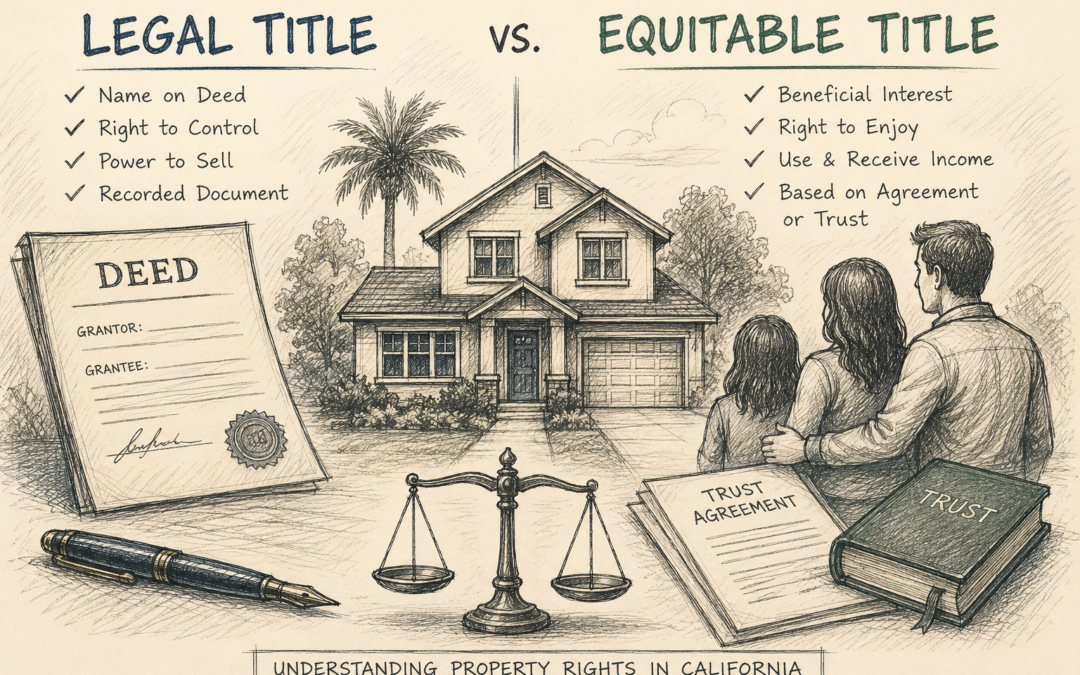
When people discuss property ownership, they usually refer to the name on the deed. However, California law recognizes a crucial distinction between equitable title vs. legal title. Understanding this difference is vital for anyone involved in a real estate transaction, a trust, or a co-ownership dispute. While one person may appear as the owner on paper, another may hold the “true” beneficial interest in the property.
Below, we break down these two forms of ownership, how they interact under the California Evidence Code, and why they matter in real-world litigation.What is Legal Title?
Legal title refers to “apparent” ownership, it is the ownership recognized by the court and government through a written instrument, such as a properly recorded deed. If your name is on the deed recorded at the county office, you hold legal title.
Rights of a Legal Title Holder:
- The power to manage and control the property.
- The authority to sell, lease, or transfer the property (subject to any fiduciary duties).
- The right of “alienability”, the power to decide who gets the property next.
Under California Evidence Code Section 662, there is a legal presumption that the person who holds legal title also holds full beneficial (equitable) title. Overcoming this presumption requires “clear and convincing” evidence.What is Equitable Title?
Equitable title represents a “beneficial interest” in the property. It is the right to enjoy the benefits of the land—such as living in the home or receiving rental income, even if your name is not on the deed.
Common Examples of Equitable Title:
- Trust Beneficiaries: In a trust, the trustee holds legal title (to manage the asset), while the beneficiaries hold equitable title (to enjoy the benefits).
- Home Buyers: Once a purchase agreement is signed, the buyer has an “equitable” interest in the home, even though the seller keeps the legal title until the closing day.
- Land Sales Contracts: A buyer paying off a property in installments holds equitable title until the final payment is made.
Key Differences: Equitable Title vs. Legal Title
The relationship between these two can be thought of as a division between administration and enjoyment.
| Feature | Legal Title | Equitable Title |
| Documentation | Name is on the recorded deed. | Based on a contract, trust, or agreement. |
| Primary Power | Manage, sell, and control. | Use, enjoy, and receive income. |
| Quiet Title | Can bring a quiet title action. | Generally cannot sue legal owner for quiet title (except for fraud). |
Why This Matters in California Litigation
1. Partition Actions
A common misconception is that you must be on the deed to file a partition lawsuit. In California, a holder of equitable title—such as a trust beneficiary—is legally entitled to sue for a partition action to force a sale of the property.
2. Quiet Title Actions
Generally, an equitable owner cannot file a quiet title action against the legal owner. However, there is a major exception: fraud. If the legal title was stolen or acquired through fraudulent promises, the equitable owner can sue to have the legal title transferred to them.
3. Divorce and Probate
In probate cases, property that was not properly titled in a trust may have to go through the court system, delaying distributions to the equitable heirs.
Frequently Asked Questions (FAQ)
Q: Can one person hold both legal and equitable title?
A: Yes. This is the most common form of ownership. When you own a home outright with no trust involved, you hold both titles simultaneously.
Q: Can a beneficiary with equitable title sell the property?
A: No. Only the trustee or person with legal title has the power to sign a deed for a sale, unless the trust documents provide a specific exception.
Q: Does having equitable title mean I own the property?
A: In the eyes of equity, yes. California courts have stated that “the owner of an equitable title is the owner of real property” and can maintain legal actions to protect their rights.
Protecting Your Property Interests
Disputes involving equitable title vs. legal title are complex and often require clear and convincing evidence to resolve. Whether you are a trust beneficiary being denied your rights or a co-owner facing a partition, early legal intervention is key.
To discuss your situation, contact Schorr Law to schedule a consultation with our real estate litigation and partition attorneys. Call (310) 954-1877 to discuss how we assist property owners in resolving complex co-ownership disputes.
About the Author
Zachary D. Schorr is a California real estate litigation attorney and the founding attorney of Schorr Law. He represents clients in specific performance actions, partition lawsuits, quiet title disputes, and complex real estate litigation throughout Southern California.
📍 Schorr Law
Call Us: (866) 999-2990
📧 zschorr@schorr-law.com
Full Bio | Contact | Instagram | View All Articles