

Updated on July 1, 2026
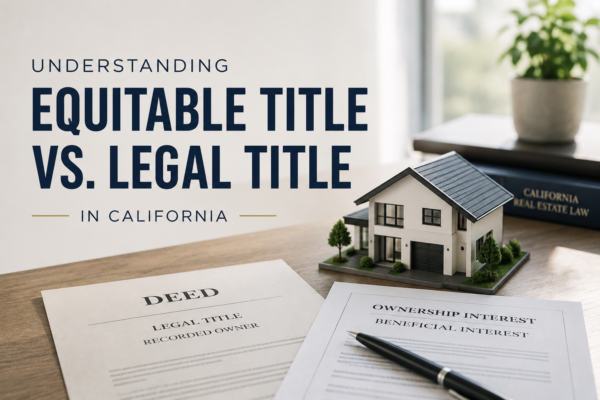
Understanding Equitable Title vs. Legal Title in California
Equitable title vs. legal title: Legal title is the formal ownership interest generally shown by a deed or other written instrument, while equitable title is the beneficial interest in the property. In California, the legal title holder is presumed to hold the full beneficial title, but that presumption may be challenged with clear and convincing proof.
Ownership of real property is not always as simple as whose name appears on the deed. Although legal and equitable title often belong to the same person, they may be separated in trusts, real estate transactions, probate matters, and ownership disputes. Understanding the difference is essential when deciding who has the right to control, use, benefit from, or bring a claim concerning the property.
Below, we explain these two forms of ownership, how they interact under California law, and why the distinction matters in real-world litigation.
What is Legal Title?
Legal title refers to the formal or apparent ownership recognized through a written instrument, such as a deed. If your name appears as an owner on a deed recorded with the county recorder, you generally hold record title. A deed is strong evidence of ownership, but it may not tell the complete story when another person claims a beneficial interest.
Depending on the form of ownership and any duties owed to another person, a legal title holder may have:
- The power to manage and control the property.
- The authority to sell, lease, or transfer the property (subject to any fiduciary duties).
- The right of “alienability”, the power to decide who gets the property next.
Under California Evidence Code Section 662, there is a legal presumption that the person who holds legal title also holds full beneficial (equitable) title. Overcoming this presumption requires “clear and convincing” evidence. Just because you have the technical right to do the things listed above, does not mean you possess that right to the extent you are exercising the right over the objection or without the consent of the equitable title owner.
Those rights may be limited by a trust, contract, court order, co-ownership arrangement, fiduciary duty, or a competing equitable interest. For a broader explanation of how deeds and ownership differ, see Schorr Law’s guide to deed vs. title in California real estate.
What is Equitable Title?
Equitable title represents a beneficial interest in property. It may include the right to use or enjoy the property, receive income from it, or obtain legal title when agreed conditions are satisfied, even though another person currently holds record title.
Common Examples of Equitable Title:
- Holding Title as a Confidant: Sometimes due to credit reasons people hold title to the property that they actually do not own – as a favor for a loved one or friend. This happens all the time due to bad credit, creditors and other reasons.
- Land Sales Contracts: A buyer paying off a property in installments holds equitable title until the final payment is made.
- A purchase agreement awaiting closing: A buyer under an enforceable real estate contract may claim an equitable interest before the deed is delivered, depending on the contract and surrounding facts.
Equitable Title vs. Legal Title in California: Quick Comparison
Equitable title does not automatically override a recorded deed. The person asserting the equitable interest must identify a valid legal or equitable basis and support it with evidence.
The relationship between these two can be thought of as a division between administration and enjoyment.
| Issue | Legal Title | Equitable Title |
|---|---|---|
| Basic meaning | Formal or record ownership recognized through a deed or other instrument. | Beneficial ownership or a right to use, enjoy, receive value from, or obtain title to the property. |
| Typical documentation | A recorded deed or other title instrument. | A contract, trust, written agreement, payment history, communications, or facts supporting an equitable remedy. |
| Typical holder | Record owner, seller under an installment arrangement, or trustee. | Buyer under a contract, trust beneficiary, or person claiming beneficial ownership. |
| Primary rights | Management, transfer, leasing, and control, subject to other rights and duties. | Use, enjoyment, income, value, or the right to obtain legal title, depending on the arrangement. |
| California presumption | The legal title holder is presumed to hold the full beneficial title. | A contrary claim generally requires clear and convincing proof. |
| Litigation relevance | Provides the stronger starting position in a title dispute. | May support quiet title, declaratory relief, constructive trust, resulting trust, fraud, specific performance, or another claim, depending on the facts. |
| Partition relevance | A qualifying co-owner may seek partition. | A claimant may first need the court to establish the claimed ownership interest and right to partition. |
How California Evidence Code Section 662 Applies?
California Evidence Code section 662 states that the owner of legal title is presumed to be the owner of the full beneficial title. The statute also provides that this presumption may be rebutted only by clear and convincing proof.
In practical terms, the deed is the starting point. The person claiming that beneficial ownership differs from record title carries a significant evidentiary burden. “Clear and convincing” is a higher standard than the ordinary preponderance-of-the-evidence standard used in many civil disputes.
The presumption can become important in disputes involving:
- A family member or friend who agreed to hold title for someone else;
- Trust property and disagreements between trustees and beneficiaries;
- Fraud, false promises, undue influence, or a disputed transfer;
- Buyers who performed under a purchase or installment agreement;
- Probate property that was not titled as intended; and
- Co-owners who disagree about their actual ownership percentages.
The presumption does not decide every dispute by itself. Courts examine the deed, the reason title was taken in that form, the parties’ agreements and conduct, and the legal theory asserted.
Schorr Law’s related article, “If My Name Is on the Deed, Do I Own the Property?”, explains why record title is important without always being conclusive.
Why This Matters in California Litigation?
1. Partition Actions
A person does not necessarily have to appear on the recorded deed to assert an ownership interest. However, someone claiming equitable title may first need the court to establish that interest and determine whether the person qualifies to seek partition under California law.
2. Quiet Title Actions
An equitable title holder may be able to pursue a quiet title action, but the claim depends on its factual and legal basis. Because the record owner benefits from the presumption under Evidence Code section 662, the claimant may need clear and convincing evidence of fraud, an enforceable agreement, a constructive or resulting trust, breach of fiduciary duty, or another basis for recognizing the claimed interest.
3. Trust, Probate, and Family Property Disputes
In trust and probate matters, legal and beneficial ownership may be held by different parties. If property was intended to be held in a trust but was not properly transferred, a probate or trust-court proceeding may be required before the property can be administered or distributed. Similar title questions may arise in family property disputes, although marital-property rules require a separate analysis.

Can You Own Property Without Being on the Deed?
Yes, a person may claim an equitable ownership interest without appearing on the deed, but contributing money or living at the property does not automatically create title. The claim must rest on a recognized basis, such as a contract, trust, intended ownership arrangement, fraud, constructive trust, resulting trust, or another equitable doctrine.
For example, if one person supplied the purchase funds while another agreed to hold title for that person, the payment records and evidence of the parties’ intent may become central. In a trust, the trust instrument may expressly separate the trustee’s legal title from the beneficiary’s beneficial interest. Under a land sale contract, the buyer’s equitable interest may arise from the enforceable agreement and performance.
What Evidence Can Help Prove Equitable Title in California?
Equitable-title disputes are evidence-driven. No single checklist proves every claim, but the following records may help show how the parties intended to own and benefit from the property:
- Purchase agreements, installment contracts, and escrow instructions;
- Trust instruments and amendments;
- Written agreements describing who would own the property;
- Bank records showing the down payment, mortgage payments, or purchase funds;
- Property tax, insurance, repair, improvement, and maintenance records;
- Rental records showing who collected income or paid operating expenses;
- Emails, text messages, letters, and other communications showing intent;
- Documents explaining why record title was placed in another person’s name;
- Evidence of fraud, reliance, undue influence, or false promises; and
- Witness testimony consistent with the contemporaneous documents and conduct.
Payment evidence can be important, but financial contributions alone may not establish ownership. The court must connect the evidence to the specific claim and determine whether the applicable burden of proof has been met. Preserving original documents and obtaining legal advice before transferring, refinancing, or selling the property can be critical.
Can an Equitable Title Holder File a Partition Action?
Potentially, but the result depends on the nature of the interest and the facts. A partition action is generally used to end concurrent ownership by dividing the property, ordering a sale, or approving another available form of partition. California Code of Civil Procedure section 872.210 identifies the persons who may commence and maintain a partition action.
When ownership itself is disputed, Code of Civil Procedure section 872.610 allows the parties’ interests to be put in issue, tried, and determined in the partition action. A person claiming equitable title may need to establish the claimed ownership interest before obtaining partition relief.
Schorr Law’s published partition matters show how different ownership disputes can develop after co-ownership is established:
- Summary judgment involving three inherited Los Angeles rental properties;
- A Santa Monica apartment-building dispute involving a trust and a co-owner;
Frequently Asked Questions (FAQ)
Can one person hold both legal and equitable title?
Yes. This is the most common arrangement. Unless a trust, contract, or competing beneficial interest separates the two, the record owner generally holds both legal and equitable title.
Does having equitable title mean I own the property?
Equitable title is a recognized beneficial interest in property, but it does not necessarily provide all the rights of legal ownership. The nature and extent of the interest depend on the agreement, trust, evidence, and applicable California law.
Protecting Your Property Interests
Disputes involving equitable title and legal title are fact-specific and may require clear and convincing evidence to overcome the record-title presumption. Whether you are a trust beneficiary, record owner, buyer, or co-owner facing partition, promptly reviewing the deed, agreements, payment records, and communications may help protect your position.
To discuss your situation, contact Schorr Law to schedule a consultation with our real estate litigation and partition attorneys. Call (310) 954-1877 to discuss how we assist property owners in resolving complex co-ownership disputes.
About the Author
Zachary D. Schorr is a California real estate litigation attorney and the founding attorney of Schorr Law. He represents clients in specific performance actions, partition lawsuits, quiet title disputes, and complex real estate litigation throughout Southern California.
📍 Schorr Law
Call Us: (866) 999-2990
📧 zschorr@schorr-law.com
Full Bio | Contact | Instagram | View All Articles
Facing a dispute over who truly owns a property? Schorr Law represents clients throughout California in partition actions, quiet title lawsuits, trust disputes, and other complex real estate litigation. Contact our team today to discuss your rights.